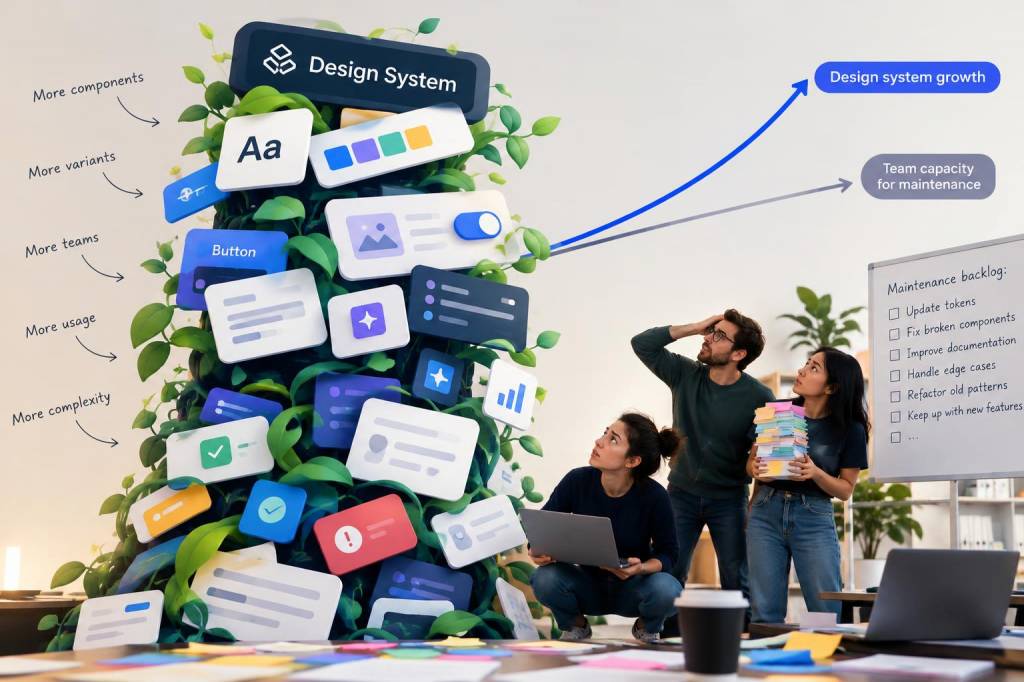
I have seen a design system become a source of speed, alignment, and confidence, and I have also seen one become a quiet liability when it grows faster than a team can actually maintain it. At first, expansion feels like success. More products adopt it. More teams rely on it. More components appear. More requests land in the backlog. For a while, it looks like momentum. Then, almost without warning, small inconsistencies start to multiply, documentation drifts away from reality, and people begin to work around the system instead of with it.
That moment is rarely dramatic. It does not arrive with alarms. It shows up in tiny fractures: a button variant that exists in one library but not another, a spacing token that means one thing in Figma and something slightly different in code, a component that was meant to be reusable but now has so many exceptions that nobody trusts it. When I have worked with teams in this situation, I have noticed that frustration is often not about design quality alone. It is about maintenance debt, and maintenance debt can make even a strong system feel unreliable.
When growth outpaces stewardship
A design system is not a static asset. It behaves more like a living product, and living products need care. When growth outpaces stewardship, every new feature or page can add more complexity than the team can absorb. A system may start with a clear set of foundations, but over time it becomes a patchwork of decisions made under pressure. A feature team needs one extra state, so they add it. Another team needs a faster delivery path, so they copy a component and modify it locally. Soon enough, usage spreads faster than governance.
I think this happens because success changes the system’s role. At first it serves a small circle of designers and developers. Later it becomes infrastructure for multiple squads, multiple brands, and possibly multiple platforms. That expansion is healthy in principle, but without enough people dedicated to upkeep, every new consumer increases the cost of consistency. The system becomes harder to understand, harder to update, and harder to trust.
One of the first symptoms I notice is version confusion. Different teams use different snapshots of the library. Documentation describes one behavior while production ships another. Designers open a component spec and assume it is current, only to discover that engineering has already worked around it three releases ago. Once that gap opens, the system stops being a shared language and turns into a set of competing references.
What breaks first
Usually, structure breaks before visuals do. The interface may still look polished, but beneath that polish, the system becomes inconsistent in ways that users eventually feel. Button hierarchy changes from page to page. Form errors appear in different styles. Spacing rhythm loses coherence. Accessibility patterns vary depending on who built the screen. These may seem like small issues individually, yet together they create an experience that feels less intentional.
Maintenance strain also affects decision-making. Instead of asking, “Which pattern serves users and scales well?” teams start asking, “Which pattern is easiest to get through this sprint?” That shift is subtle, but it matters. Short-term convenience can accumulate into long-term fragility. I have watched teams add just enough custom logic to get a feature launched, then spend months trying to merge that logic back into a shared component that was never designed for those edge cases.
Another early breakage point is documentation. Documentation is often treated as a nice-to-have, but in a fast-growing system it is part of the product itself. If the docs lag behind reality, people stop using them. Once that happens, tribal knowledge replaces shared knowledge. New team members learn by asking around. Experienced members rely on memory. Important rules become informal habits instead of explicit standards.
The hidden cost of too many exceptions
Exceptions sound harmless when they are introduced one at a time. A special case here. A one-off override there. A unique variant for a launch campaign. But each exception adds surface area. It creates another branch of logic, another visual state, another accessibility scenario, another code path to test. Over time, the system becomes less like a system and more like a collection of negotiated compromises.
I have learned to pay attention to which exceptions repeat. If the same exception appears in three different product areas, it is no longer an exception. It is a signal that the core pattern may be missing something important. Teams often try to preserve purity by treating those requests as outliers, but that can backfire. A system that refuses to evolve becomes irrelevant. A system that absorbs every request without discipline becomes bloated. The real work is deciding which deviations deserve to become first-class patterns and which should remain rare.
There is also a psychological cost. When contributors believe the system is too brittle to handle real needs, they lose confidence in it. Once trust drops, adoption drops with it. Designers start bypassing the library. Developers stop checking for existing patterns. Product teams create bespoke solutions because they assume the shared system will slow them down. At that point, the issue is not just technical debt. It is social debt.
What I look for when a system feels overloaded
When I review a design system that seems to be growing faster than it can be maintained, I look for a few clear signs:
- Components exist in multiple near-identical versions with no clear ownership.
- Documentation trails implementation by several releases.
- Design tokens are defined in one place but overridden in many others.
- Teams rely on direct edits instead of contributing upstream changes.
- Accessibility behavior varies depending on the implementation path.
- There is no consistent review process for adding or changing components.
- Usage is high, but contribution is concentrated in only one or two people.
When several of these are true at once, I know the system is not just busy. It is under structural stress. The problem may not be visible in executive dashboards, but it is visible in the work itself: slower delivery, repeated debates, and rising inconsistency.
How teams usually respond, and why that is not enough
The most common response is to add more process. More meetings. More approval layers. More templates. More review gates. Sometimes that helps, but only if the underlying system has enough clarity to support those controls. If the foundation is already unstable, more process can feel like pouring water into a cracked container.
Another common response is to freeze the system. No new components. No new variants. No new patterns unless absolutely necessary. A freeze can be useful for a short period because it creates breathing room, but it is not a long-term strategy. Products keep changing. User needs keep changing. The market keeps changing. A frozen system may preserve order for a while, yet it can also force product teams to work around it in quieter, messier ways.
What I have found more effective is narrowing the system’s responsibilities. A design system does not need to solve every problem. It needs a clear scope. If it is trying to support too many products, too many brands, or too many interaction models at once, it may need boundaries that are much sharper than the team is willing to admit.
How I would stabilize a system in that state
If I were stepping into a system that had outgrown its maintenance capacity, I would start by reducing ambiguity. I would want a clear inventory of what exists, who owns each part, and which components are actively used. That inventory would probably reveal that a surprising amount of the library is either duplicated, outdated, or only partially adopted.
Then I would separate core patterns from experimental ones. Core patterns deserve stability, documentation, and support. Experimental patterns can exist, but they should be labeled as such and reviewed on a defined cadence. That distinction matters because not every idea belongs in the same level of permanence.
I would also push for a stronger contribution model. If only one small group can update the system, it will become a bottleneck. But if everyone can change it without guardrails, it will fragment. The middle ground is a clear contribution path with ownership, review criteria, and a predictable release process. Teams need to know how to request a change, how to test it, and how to decide whether it should be merged.
Finally, I would prioritize components that have the greatest blast radius. In practice, that usually means forms, navigation, buttons, modals, and layout primitives. If those are inconsistent, every downstream screen becomes harder to trust. Repairing high-impact foundations usually delivers more value than polishing edge cases.
What sustainability looks like in practice
A sustainable design system is not one that never changes. It is one that can change without collapsing under its own weight. That requires honest tradeoffs. Sometimes it means removing components that no longer earn their place. Sometimes it means simplifying a token architecture that has become too clever for its own good. Sometimes it means accepting that a feature team needs a temporary exception, but only with a plan to reconcile it later.
I like systems that are opinionated in the right places and flexible in the right places. Strong opinions about spacing, type scale, and interaction states help teams move quickly without reinventing basics. Flexibility around composition and content structure helps products adapt to real-world needs. The balance is delicate, but when it works, the system feels light instead of heavy.
Over time, I have come to believe that a growing design system is not a success problem or a failure problem. It is a stewardship problem. Growth is normal. Strain is normal. What matters is whether the team has the capacity, rituals, and clarity to keep the system legible as it expands. Without that, even a beautiful system can become an obstacle. With it, growth becomes manageable, and the system can remain something people actually want to use.
| Signal | What it usually means | Practical response |
|---|---|---|
| Many duplicate components | Ownership is unclear | Audit usage and merge overlapping patterns |
| Docs do not match production | Maintenance is falling behind | Assign documentation ownership and release checks |
| Frequent one-off overrides | Core patterns are too rigid or incomplete | Review repeated exceptions and promote common needs |
| Low trust in the library | Teams do not believe the system is current | Improve transparency, versioning, and contribution flow |
When I think about a design system in this state, I do not see a broken idea. I see a successful idea that needs a stronger operating model. That distinction matters, because it changes the question from “Is this worth saving?” to “What would make it maintainable again?”