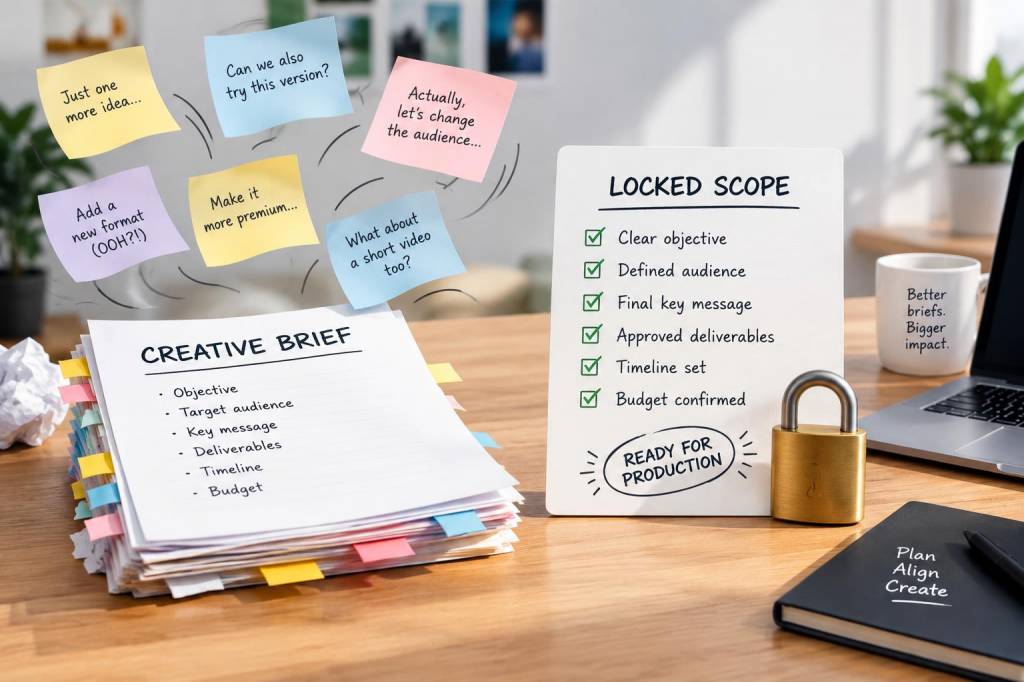
I have seen the same pattern over and over: a creative brief arrives looking clear, everyone nods in agreement, and then production begins. A week later, the project has grown new features, new audiences, new pages, and new opinions. What started as a focused assignment now feels like a moving target. In my experience, brief drift rarely happens because people are careless. It happens because the early decisions were never made explicit, and once production starts, every unanswered question becomes a tempting place to improvise.
For me, scope control is not about being rigid. It is about making enough decisions early so the creative team can stay creative without constantly reopening the same conversations. When scope is vague, design becomes negotiation, copy becomes placeholder, and development becomes guesswork. When scope is locked too late, the project pays for it in delays, revisions, and morale. I have learned that if I want a project to stay healthy, I need to treat the brief as a working agreement, not a suggestion.
Why briefs drift once work begins
Most drift starts with optimism. A client or stakeholder assumes a request is simple, so they leave room for flexibility. A creative team hears that flexibility and assumes it will be resolved later. Then production begins, and every missing detail gets filled in by someone who is under pressure to keep moving. That is where drift sneaks in. It does not usually arrive as a dramatic change. It appears as small additions: one more page, one more audience segment, one more animation, one more approval round.
I think drift is also a symptom of emotional comfort. Early conversations feel safe because nothing is costly yet. Once mockups, content drafts, and build estimates exist, people become attached to possibilities they had not fully considered before. They start asking for “just a few adjustments” because the project feels more tangible. At that point, the brief has stopped behaving like a plan and started behaving like an invitation.
Another reason is that many briefs describe desire rather than decision. They say a brand wants to look modern, a campaign wants to feel premium, or a landing page wants to increase conversion. Those are useful starting points, but they do not define what is in scope, what is out of scope, or what success looks like in practice. Without those boundaries, every new idea can claim equal legitimacy.
What I lock before production starts
Before any serious production work begins, I want five things to be clear: objective, audience, deliverables, constraints, and approval path. If one of those is fuzzy, I know the project is still vulnerable to drift.
- Objective: What result should this project create?
- Audience: Who is this for, and who is not the priority?
- Deliverables: What exact assets, pages, or formats are included?
- Constraints: What budget, brand, content, legal, or technical limits exist?
- Approval path: Who gives final sign-off, and in what order?
Those five items sound obvious, but I have seen entire projects wobble because one of them was implied instead of written down. For example, if a landing page is meant to support paid traffic, then the page structure, message hierarchy, and measurement plan should reflect that from day one. If the audience is internal staff rather than external customers, then tone, visual density, and navigation choices may need to change. If the approval path includes six voices but only one final decision-maker, that needs to be known before the first concept review.
I also lock practical boundaries early. That means I define what a revision is, what counts as a new request, and what triggers a scope change. This is where many projects fail quietly. People assume revisions are unlimited because nobody set a number. Or they think a new feature request is a minor tweak because the brief never defined the original feature set clearly enough. I prefer to spell those things out in plain language before production starts, even if that feels slightly formal.
Questions I ask in the briefing phase
When I want to stop drift before it starts, I ask questions that force specificity. I am not trying to complicate the project. I am trying to remove room for later interpretation.
- What problem is this solving right now?
- What would a successful outcome look like after launch?
- What is included in this phase, and what is intentionally excluded?
- Which messages must stay unchanged?
- Which audience segment matters most?
- What content already exists, and what still needs to be created?
- Which stakeholders must approve work, and who has final authority?
- What deadline is fixed, and what deadline is flexible?
- What technical, brand, or legal constraints should shape decisions?
These questions do more than gather information. They reveal where confidence is real and where it is assumed. Often, the answers uncover disagreement before production has made it expensive. I would rather spend an extra hour clarifying a brief than an extra week untangling a direction that changed after design had already been approved.
Why written scope matters more than verbal alignment
I do not trust verbal alignment as far as I can throw it. That sounds harsh, but I have learned that enthusiasm in a meeting does not survive contact with a live project. People remember conversations differently, especially when deadlines tighten and opinions get stronger. Written scope gives everyone something concrete to reference when memories start to blur.
A good scope document does not need to be long. It needs to be unambiguous. I like documents that state what is being created, what success means, what is excluded, and what changes require approval. If the project is complex, I also include assumptions. Assumptions are useful because they show where the plan depends on things that have not been confirmed yet. Once those assumptions are visible, they can be validated or corrected before work deepens.
In practice, I often create a short scope summary after the kickoff meeting and send it back for confirmation. This is not a formality. It is a checkpoint. If someone says, “Actually, we also need a version for a second audience,” that is a signal to pause and reassess. If I wait until production is underway, that same request becomes a source of tension rather than a useful correction.
What I use to keep scope from expanding silently
I rely on a few habits that sound small but save a lot of time. First, I separate ideas from commitments. During early discussions, many ideas are welcome, but not every idea becomes part of the active scope. I keep a parking lot for future opportunities so the team feels heard without letting the current phase expand uncontrollably.
Second, I make decision points visible. If the project needs approval on positioning, messaging, wireframes, and visual direction, I put those checkpoints on a timeline. That way, nobody assumes a later stage can absorb earlier uncertainty. Each decision has a moment, and each moment has an owner.
Third, I track changes in a way that makes their impact clear. If a request adds work, I name the effect on time, cost, quality, or launch date. That does not mean every change is rejected. It means every change is understood. I have found that people are far more willing to make tradeoffs when the tradeoff is explicit.
| Scope Signal | What It Usually Means | What I Do Next |
|---|---|---|
| “Can we also add…” | Potential expansion of deliverables | Check objective, budget, and timeline impact |
| “I assumed that was included” | Missing boundary in the brief | Restate exclusions in writing |
| “Let’s explore a few more directions” | Unresolved decision criteria | Clarify which criteria will decide the direction |
| “We can decide that later” | Deferred risk | Move the decision into a scheduled checkpoint |
| “It should be quick” | Unpriced work | Estimate the effort before agreeing |
How I handle scope changes without losing momentum
I do not pretend scope changes never happen. They do, and sometimes they should. Markets shift, leadership changes direction, content evolves, or a better opportunity appears midstream. The real issue is whether the change is managed or absorbed invisibly.
When a new request appears, I ask three things: does it support the original objective, what does it replace, and what does it cost? If it strengthens the project and the team can absorb it without damage, I may accept it. If it adds value but threatens schedule or quality, I present options. For example, we might keep the launch date and cut a lower-value feature, or keep the feature and move the launch. That kind of tradeoff conversation is much healthier than pretending everything can be added for free.
I also make a distinction between discovery and revision. Discovery is when we are still learning what the project needs. Revision is when the project has already been defined and only refinement remains. If a stakeholder keeps uncovering major new needs after production has started, I treat that as a sign that the brief was not fully settled, not as a failure of execution. That distinction matters because it changes the response. The answer may be to revisit scope, not to push harder on delivery.
What I want every creative team to remember
If there is one thing I wish more teams understood, it is that scope does not lock creativity out. It protects creativity from chaos. A clear brief gives designers, writers, strategists, and developers room to solve the real problem instead of chasing a moving target. It also gives clients a better experience because progress becomes visible, decisions become easier, and the project feels deliberate rather than reactive.
I have worked on enough projects to know that drift is not always visible at first. It begins with polite uncertainty, a few hopeful assumptions, and a reluctance to say no too early. But once I learned to define objective, audience, deliverables, constraints, and approval path before production begins, the entire process became calmer. The work got sharper, the conversations got shorter, and the final result started to resemble the original intent instead of a compromise assembled under pressure.
So when a brief starts to wobble, I do not ask for more inspiration. I ask for more definition. I ask what belongs, what does not, and who has the authority to decide. That is usually where the project steadies again.